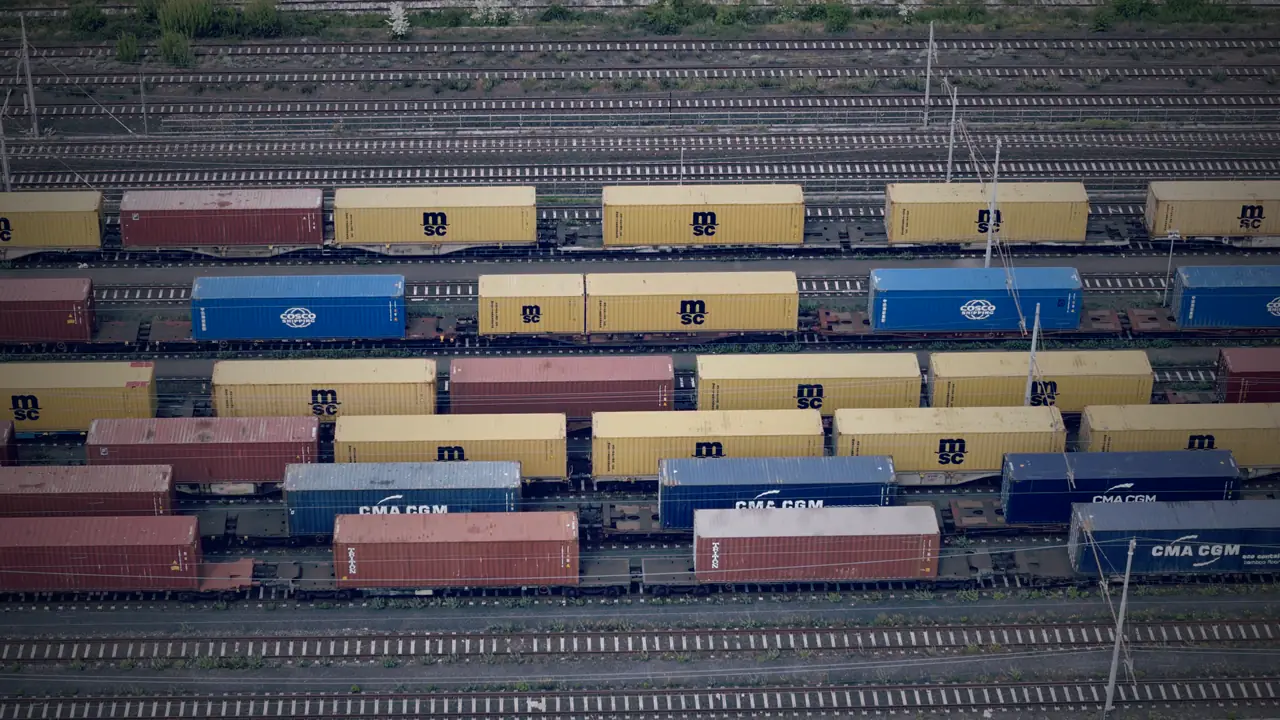
Between sea and air there’s a gap, and that’s where rail comes in. Your cargo leaves China by train, crosses Asia and Europe overland and reaches your door in 30–35 days. It isn’t right for everything, but for some cargo it fits better than the other two. Here’s which, and what changes compared with a sea shipment.
Sea, rail or air, side by side
| Sea | Rail | Air | |
|---|---|---|---|
| Transit time | We give it to you with the quote: it depends on the shipping line, the port and the port calls | 30–35 days door to door | 24–48 h for urgent shipments |
| CO2 footprint | Very low | Very low | The highest, by far |
| Suits | Large volumes and generous lead times | Stock that can’t wait for the ship | Urgent shipments and high value per kilo |
The footprint of each mode comes from the European Environment Agency’s comparison. For your own shipment, with its route and weight, use the carbon footprint calculator.
When rail suits you
- When the ship takes too long. Your stock can’t hold out for a sea shipment and air would wreck your margin.
- When the sea route gets complicated. In 2024, much of the traffic between Asia and Europe stopped crossing the Red Sea and the Suez Canal and went round Africa via the Cape of Good Hope, according to UNCTAD. When that happens, the sea voyage gets longer. Rail doesn’t depend on those passages.
- When you sell by season. The product has to be in store by a certain date and you can’t order it as far ahead as the ship requires.
- When you want to spread the risk. Part by rail and part by sea: if one is delayed, the other keeps arriving.
And when it doesn’t. If your cargo is genuinely urgent, air freight arrives in 24–48 hours. And if you move large volumes with no rush, compare sea freight too, in a full container or groupage.
What changes when you go overland
- Two rail regimes, one consignment note. Between Europe and Asia, rail freight is governed by two different legal regimes, CIM and SMGS. Where they meet, the consignment note has traditionally been reissued. To avoid that, there is a common CIM/SMGS consignment note.
- The safety and security declaration applies to rail too. The ENS isn’t just for sea and air. All goods entering the European Union, by any means of transport, need an entry summary declaration in the ICS2 system, with the cargo data before it arrives.
- Customs, in Spain. The train enters the European Union a long way from here. Under the transit procedure, the goods can continue with duties and VAT suspended and be cleared at destination. You pay in Spain, and our customs team works it out for you before departure.
Before your first rail shipment
- Check the Incoterm if you buy FOB or CIF. According to the International Chamber of Commerce, FAS, FOB, CFR and CIF are rules for sea and inland waterway transport. For rail, use the rules for any mode of transport: FCA if you arrange the transport from China yourself, or CPT and CIP if your supplier arranges it.
- Ask for the date the cargo will be ready, not the production date. With that, we find the departure that fits and give you the real transit time.
- Have the usual paperwork to hand. Commercial invoice, packing list and the TARIC code for each product. Clearance in Spain is prepared just as if the goods arrived by sea.
What we confirm with every quote
We don’t quote brochure frequencies or a standard departure city. Whatever changes from one shipment to the next, we confirm in writing:
- Where your goods are loaded in China and how they get to the departure terminal.
- The route and transit time of your shipment.
- How the final delivery to your door is made, by road or by rail.
- What the price includes and what it leaves out.
If your supplier is a long way from the rail departure point, we tell you that too: sometimes the leg to the terminal changes the numbers. And if your cargo has special requirements, such as dangerous goods, liquids or high value, we look at it before booking.
And once it reaches Spain
Once it’s cleared, we deliver it anywhere in mainland Spain, by road or by rail. If you don’t need it all at once, it can wait in our warehouses in Bilbao or Gijón, with full visibility of your stock, and go out as you call it off.
If you’re weighing up every way of bringing cargo in from China, by sea, air or rail, see how they compare in international freight. And if you already have an order under way, send us the volume and the date it will be ready: with that, we’ll tell you whether rail suits you and at what price.