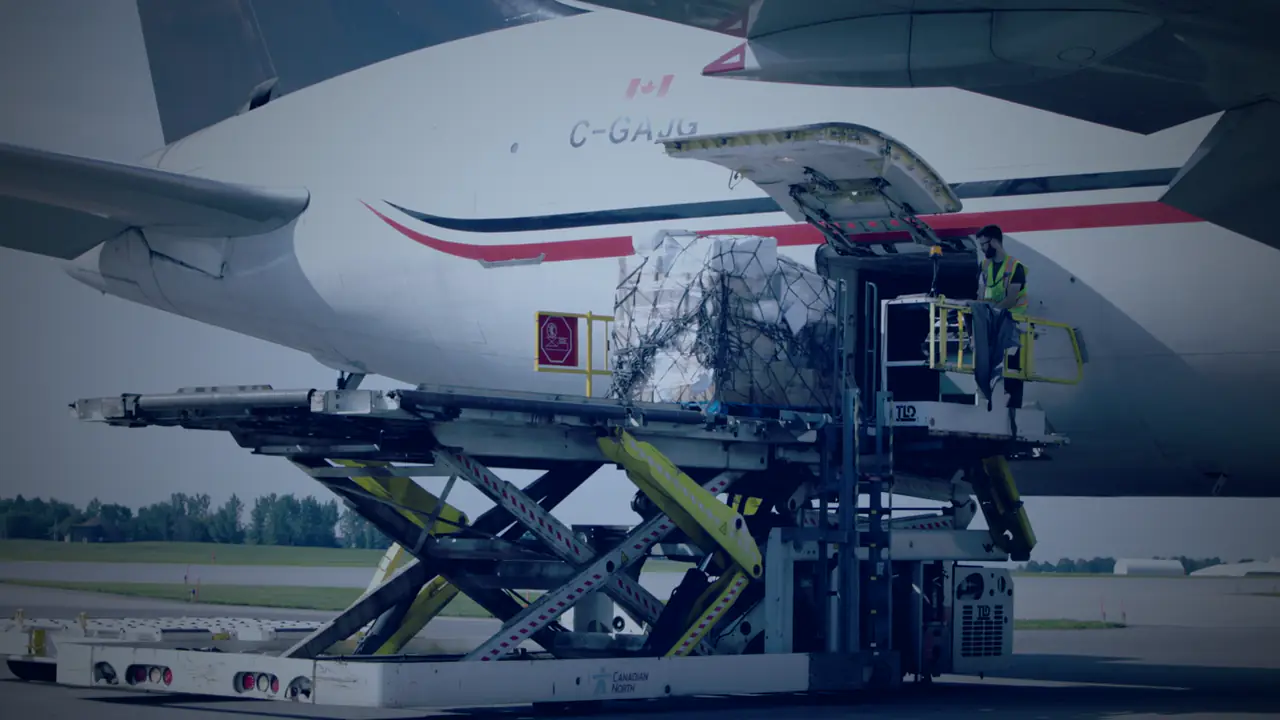
By air you pay more per kilo and gain weeks. That is the whole equation. The useful question isn’t whether flying is expensive, but whether not flying would cost you more. An urgent shipment can be here in 24–48 hours, with daily departures from any origin. We help you decide when it’s worth it and pay only for what really has to fly.
When paying for air makes sense
- When stopping costs more than flying. A machine standing idle waiting for a spare part, a building site that can’t move forward without one component. That’s when air freight is the cheap option.
- When the goods are worth a lot and weigh little. If the freight is a small share of what the box is worth, paying more for it barely changes your margin.
- When the sale has a date. A campaign, a trade fair, a sample to close an order. Arriving late is worth nothing.
- When the product loses value over time. Perishables or seasonal fashion, which are worth less with every week they spend in transit.
And when it doesn’t: bulky, low-value cargo, or orders you can plan well ahead. That’s where sea freight is the logical choice. Often the best answer is to split the order: fly just enough to avoid running out of stock and ship the rest.
How your price is worked out: chargeable weight
With air freight you don’t only pay for what your cargo weighs, but also for the space it takes up. The airline compares two figures and charges for the higher one:
- The actual weight, the one on the scales.
- The volumetric weight: length × width × height in centimetres, divided by 6,000. That’s the IATA standard, although some airlines apply their own.
An example: a 100 × 80 × 60 cm box weighing 40 kg has a volumetric weight of 80 kg. You pay for 80. Put another way, each cubic metre is charged as roughly 167 kg.
That’s why we go through the packaging with you before quoting. A pallet with wasted space or a box bigger than it needs to be is paid for on every flight.
What doesn’t get on a plane without paperwork
- Dangerous goods. Paints, aerosols, chemicals or batteries follow IATA’s dangerous goods regulations, which set out how they are classified, packed, marked, labelled and documented. Lithium batteries, loose or inside a device, may or may not fly depending on how they are packed and their energy in watt-hours. If your product has a battery, tell us before we quote.
- Security checks. All air cargo is screened before it is loaded onto the aircraft, unless it comes from a company in the secure supply chain: regulated agents and known consignors. If your company isn’t one, allow for that screening when you plan.
- Data before loading. To enter the European Union by air, part of the entry summary declaration (ENS) is sent before loading at origin, not just before arrival. The cargo data has to be ready, and right, before departure. Our customs team handles that, and the clearance on arrival.
Air freight from China: where it leaves and where it lands
Hong Kong and Shanghai Pudong were the world’s two busiest cargo airports in 2025, according to Airports Council International (ACI). If your supplier is near one of them, your cargo will normally leave from there.
In Spain, air cargo is concentrated at Madrid-Barajas: in 2025 it handled just over 61% of all the cargo at Aena airports. That doesn’t mean your shipment has to end its journey in Madrid. From the arrival airport, we take it by road to your door.
How to save hours on an urgent shipment
You can’t speed up the flight. The hours you can save are on the ground:
- Documents ready before collection. Commercial invoice and packing list with the real weights and dimensions. If you import, have your EORI number to hand.
- Packaging ready to fly. Packages sealed and labelled and, if they’re on pallets, with nothing sticking out.
- Someone reachable at destination. To receive the cargo and sign for it as soon as it arrives, so it isn’t left waiting on a loading bay.
What we need to give you a price
- Dimensions and weight of each package or pallet, and whether it can be stacked.
- What the goods are and whether they contain batteries, liquids or anything flammable.
- Collection and delivery addresses.
- The date it has to be at destination, not the departure date.
With that, we give you a price and a transit time in writing. If your date allows some leeway, we tell you that too: from China, rail arrives in 30–35 days door to door and is the middle ground between sea and air. And if you want to compare what each option emits, use the carbon footprint calculator. According to the European Environment Agency, air cargo is by far the highest-emitting mode.